
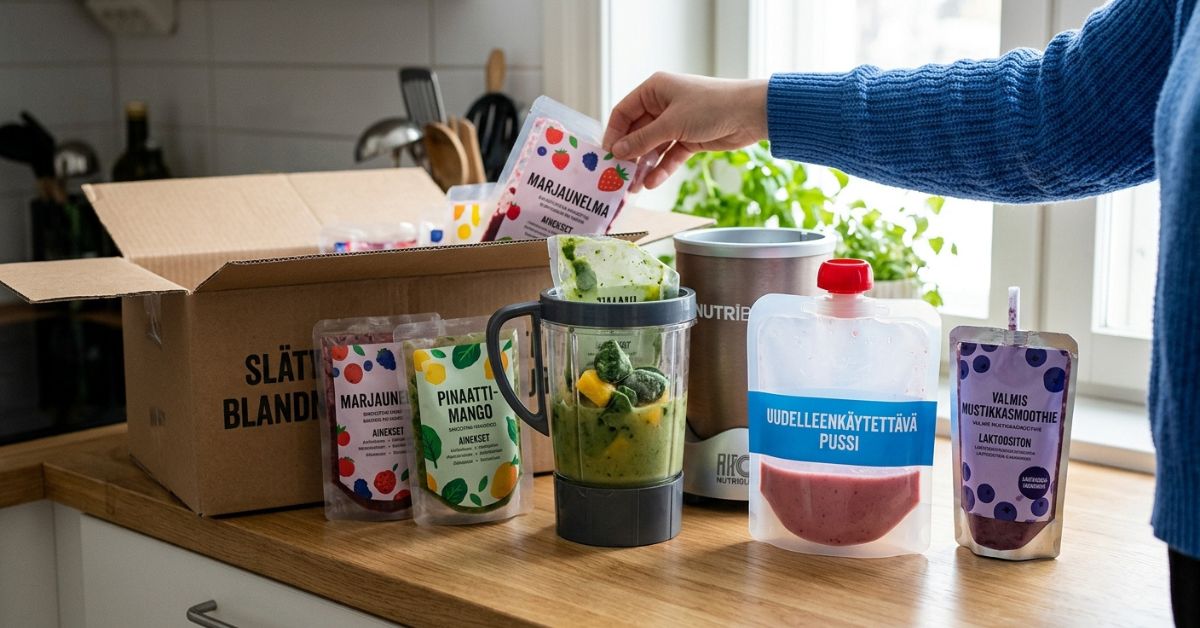
If you searched for Smoothiepussit, you may have noticed that the results do not agree on one exact definition. Some pages describe smoothie pouches, while others discuss frozen ingredient packs, reusable containers, or smoothies prepared ahead of time.
That difference is important.
A pouch holding a finished drink is not the same thing as a bag of ingredients prepared for later blending. Both can be connected with the term, but they serve different purposes.
There is also a useful linguistic clue behind the unusual spelling. In Finnish, pussi means a small bag or flexible container, while pussit is its plural form. Finnish language references therefore support an association with bags or pouches. They do not, however, establish the complete expression as a standardized Finnish food category.
This guide explains the meaning, possible origin, practical uses, ingredients, recipes, nutrition, storage, food safety, reusable containers, sustainability, cost, and common misunderstandings surrounding the term.
What Is Smoothiepussit?
In current online usage, Smoothiepussit is associated with smoothie pouches, prepared smoothie ingredients, and portable smoothie preparation.
There are several formats that can fall under this broad description.
A finished smoothie pouch contains a drink that has already been blended.
A smoothie ingredient pack contains measured ingredients that are blended later.
A reusable food pouch is simply a container that can hold a suitable food or drink. It may be used for smoothies, but the pouch itself is not a type of smoothie.
A commercial pouch may already contain a prepared product and will have its own ingredient list and storage instructions.
These differences explain why online descriptions can appear contradictory.
What Does the Term Actually Refer To?
When you encounter the word, look at the context.
Is the page discussing:
- A finished smoothie?
- A reusable pouch?
- Frozen fruit and vegetables?
- A ready to blend ingredient pack?
- A commercial food product?
- A recipe prepared for later use?
The answer changes how the product should be prepared, stored, and evaluated.
Is It a Food or a Container?
It can be discussed in relation to both, but those ideas should not be mixed together.
The food determines nutrition.
The container determines how the food can be stored, carried, or consumed.
A pouch does not automatically make a smoothie healthier, safer, cheaper, or more sustainable.
Smoothiepussit Meaning and Possible Origin
The spelling is unusual because it appears to combine an English food word with a Finnish noun.
Finnish pussi means a bag or small flexible container. Its nominative plural is pussit.
That makes “smoothie pouches” a reasonable literal interpretation of the compound.
There is an important qualification, though.
The meaning of the Finnish word can be verified independently. The status of the complete expression as a recognized Finnish commercial food category is a separate question.
Some newer online articles state that the expression is an established Nordic product category. The available evidence is not strong enough to make that claim universally. The safer explanation is that the wording is connected linguistically with pouches and is now being used online in several related ways.
What Does Pussi Mean?
Pussi refers to a bag or pouch, especially a small flexible container used for packaging, storage, or carrying something.
What Does Pussit Mean?
Pussit is the nominative plural form of pussi. In a literal context involving bags or pouches, it refers to more than one such container.
Is the Complete Expression an Official Finnish Food Term?
There is not enough reliable evidence to describe it as a universally standardized food category.
That distinction improves the accuracy of the article.
A linguistic explanation can be well supported without claiming that a particular commercial product category exists everywhere.
Why Are Online Definitions Different?
The search results show several overlapping interpretations.
One group of pages describes flexible containers filled with prepared smoothies.
Another focuses on ingredient portions that are frozen and blended later.
Some pages treat the term as a general meal preparation idea.
Others present it as a specific product category.
This variation means the best answer should not force every interpretation into one definition.
Instead, separate the food, the container, and the preparation method.
That approach also makes the information more useful for someone searching for ingredients, recipes, storage advice, or purchasing guidance.
Smoothie Pouch vs. Smoothie Pack
These terms are related but are not interchangeable.
| Format | What it usually contains | Main purpose |
|---|---|---|
| Smoothie pouch | A prepared smoothie or soft food | Carrying and consuming |
| Smoothie ingredient pack | Measured ingredients | Later blending |
| Frozen smoothie pack | Frozen measured ingredients | Advance preparation |
| Bottled smoothie | Finished drink | Ready consumption |
| Homemade smoothie | Freshly blended ingredients | Immediate use |
Smoothie Pouch
The focus is the container.
It may be reusable or disposable, depending on the product.
Smoothie Pack
The focus is preparation.
Fruit, vegetables, oats, seeds, or other ingredients are portioned in advance and blended later.
Frozen Smoothie Pack
Freezing allows ingredients to be prepared in batches.
The container must be suitable for freezing, and the ingredients should be handled appropriately before storage.
Bottled Smoothie
A bottle is normally rigid rather than flexible.
It may be convenient for transport, but the storage requirements still depend on the ingredients.
Homemade Smoothie
A fresh smoothie can be consumed immediately without using a pouch at all.
The pouch becomes useful when transport, storage, or portioning is part of the plan.
How Does the Pouch Based Method Work?
There are two main approaches.
Blend First
Prepare the smoothie normally.
Blend the ingredients until the desired texture is reached.
Transfer the finished drink into a suitable food pouch.
Seal it properly.
Refrigerate or otherwise store it according to the food and container requirements.
This method is mainly about portability.
Prepare Ingredients First
Wash and prepare the produce.
Measure individual portions.
Place the ingredients into an appropriate storage container.
Refrigerate or freeze according to the ingredients and container instructions.
Blend the portion later with the required liquid.
This method is mainly about reducing preparation time.
Ready to Drink Products
Commercial products should be handled according to their labels.
Do not assume that every packaged smoothie has the same storage requirements.
Ready to Blend Packs
These are useful when the goal is to prepare several servings ahead of time.
A pack might contain berries, banana, spinach, oats, seeds, or other recipe ingredients.
The liquid is added during blending.
Smoothiepussit Ingredients: What Can Go Into a Smoothie Pouch?
There is no universal ingredient list.
A good combination depends on taste, texture, nutritional needs, and whether the mixture will be consumed immediately or stored.
Fruits
Common choices include:
- Banana
- Strawberries
- Blueberries
- Raspberries
- Mango
- Pineapple
- Peaches
- Apples
Frozen fruit is especially convenient for make ahead ingredient portions.
Vegetables and Leafy Greens
Spinach, kale, cucumber, carrots, and other vegetables can be added to suitable recipes.
Fresh produce should be handled properly before preparation. The FDA recommends washing produce under running water and advises against washing fruits and vegetables with soap or detergent.
Yogurt
Plain yogurt can provide creaminess and protein.
Greek yogurt can make a mixture thicker and can contribute more protein than many standard yogurts.
Sweetened varieties should be checked because they may add sugar.
Oats
Oats can make a drink thicker and provide carbohydrates and fiber.
They work well in recipes intended to be more filling.
Seeds
Chia seeds and ground flaxseed can be added in moderate amounts.
They affect both texture and nutrition.
Protein Sources
Protein can come from yogurt, milk, fortified soy beverages, nut butter, seeds, or a suitable protein powder.
The right choice depends on the rest of the meal and individual dietary requirements.
Liquid Bases
Common choices include:
- Water
- Milk
- Unsweetened soy beverage
- Other suitable plant based beverages
- Yogurt combined with water
The amount of liquid controls thickness.
Smoothiepussit Benefits: What Are the Real Advantages?
The strongest benefits are practical rather than claims about the pouch itself.
Easier Morning Preparation
Preparing ingredients in advance can reduce washing, cutting, measuring, and cleanup on busy mornings.
Better Portion Planning
Individual ingredient portions make it easier to prepare similar servings repeatedly.
Convenient Transport
A suitable pouch can be useful when carrying a finished smoothie or another soft food.
Less Repeated Preparation
Instead of preparing every ingredient each day, several portions can be prepared during one session.
Ingredient Control
Homemade preparation allows you to choose the fruit, vegetables, dairy or plant based ingredients, seeds, grains, and other additions.
Useful for Meal Preparation
A weekly preparation routine can make repeated smoothie making more predictable.
What About Nutritional Benefits?
The container itself does not create a nutritional advantage.
The ingredients determine the nutritional profile.
The CDC recommends whole fruits over fruit juice because whole fruit provides fiber that helps with fullness. It also advises choosing fruits and vegetables without added sugar or syrup when possible.
That is why it is better to separate convenience benefits from nutrition claims.
Is Smoothiepussit Healthy?
There is no universal answer because there is no universal recipe.
A smoothie containing whole fruit, vegetables, plain yogurt, oats, and seeds has a different nutritional profile from one based heavily on fruit juice, sweetened yogurt, syrups, or other sweet ingredients.
The Dietary Guidelines for Americans emphasize nutrient dense foods and limiting added sugars as part of a healthy dietary pattern.
Does the Pouch Affect Nutrition?
Changing the container does not automatically change the ingredients.
Nutrition depends on what goes into the mixture.
What Makes a Smoothie More Balanced?
A practical recipe can include a combination of:
- Fruit or vegetables
- A protein source
- A fiber source
- A suitable liquid
The proportions depend on whether the drink is being used as a snack, breakfast, or part of another meal.
What About Sugar?
Fruit naturally contains sugar.
Some recipes also contain added sugar through sweetened yogurt, syrups, honey, fruit drinks, or other ingredients.
The total recipe matters more than the name attached to the product.
Can It Replace a Meal?
A smoothie can contribute to a meal, but the word itself does not guarantee that the drink provides everything a person needs.
Consider the serving size, protein, fiber, fats, carbohydrates, and the rest of the day’s food.
Smoothiepussit Recipe: A Simple Berry and Banana Version
Here is a practical example rather than a supposed standard formula.
Ingredients
- 120 grams frozen berries
- 60 grams banana
- 80 grams plain Greek yogurt
- 10 grams chia seeds
- 120 to 180 milliliters milk or another suitable liquid
- Optional cinnamon
Method
Measure the ingredients.
Add the berries, banana, yogurt, chia seeds, and liquid to a blender.
Blend until smooth.
Add more liquid if needed.
If you are preparing an ingredient pack for later, portion the suitable solid ingredients into a container intended for the planned storage method. Add the liquid and yogurt during blending when appropriate.
If you are transferring a finished drink to a pouch, use a food safe container designed for liquids or semi liquid foods.
Other Recipe Combinations
Green Version
Try spinach, banana, berries, cucumber, and a suitable liquid.
Tropical Version
Combine mango, pineapple, banana, and a suitable liquid.
Oat and Berry Version
Use berries, banana, oats, plain yogurt, and milk.
Chocolate Banana Version
Combine banana, unsweetened cocoa, plain yogurt, milk, and a small amount of nut butter.
The recipe should be adapted to the ingredients, texture, and nutritional purpose you want.
How to Prepare Smoothie Packs for Meal Prep
Start by choosing several recipes that share ingredients.
Wash the produce.
Prepare the fruit and vegetables.
Measure individual portions.
Place each portion into an appropriate container.
Label each portion with the contents and preparation date.
Refrigerate or freeze according to the food and container requirements.
When ready to make the drink, add the required liquid and blend.
This system moves most of the preparation into one planned session.
Texture Problems and How to Avoid Them
Not every recipe behaves the same way after storage.
Banana and yogurt can create a thick texture.
Oats and chia seeds continue absorbing liquid.
High water content fruit can produce a thinner drink.
Freezing and thawing can also affect texture.
If the mixture becomes too thick, add liquid gradually.
If it is too thin, reduce the liquid or add a thicker ingredient during preparation.
Do not assume that a recipe designed for immediate drinking will have the same texture after freezing.
Storage and Food Safety
Food safety is separate from convenience.
The FDA recommends keeping refrigerators at or below 40°F, or 4°C, and freezers at 0°F, or minus 18°C. It also recommends following storage instructions on food labels.
The USDA advises that perishable foods should not remain in the temperature danger zone between 40°F and 140°F for more than two hours, or more than one hour when the surrounding temperature is above 90°F.
How Long Can a Homemade Smoothie Be Refrigerated?
There is no single safe period for every homemade preparation.
The ingredients, preparation conditions, refrigerator temperature, container, and handling all matter.
Use conservative food safety practices rather than relying on a fixed number for every recipe.
Should a Smoothie Be Frozen?
A prepared ingredient pack may be frozen when the ingredients and container are suitable.
A finished drink may also be frozen in some containers, but the container must specifically allow it.
Do not assume that every pouch is freezer safe.
What About Commercial Products?
Follow the storage instructions printed on the package.
The manufacturer’s directions apply to the specific formulation and packaging.
What If a Smoothie Has Been Left Out?
If a perishable food has remained at room temperature for more than two hours, USDA guidance recommends discarding it. The limit is one hour when the temperature is above 90°F.
Food can also become unsafe without an obvious change in smell or appearance.
Cleaning a Reusable Pouch
Reusable containers require proper cleaning after every use.
Empty the container promptly.
Rinse it.
Separate removable parts when the manufacturer permits it.
Wash the food contact surfaces thoroughly.
Pay particular attention to caps, seams, valves, and narrow openings.
Allow all parts to dry completely before storing.
Do not close and store a damp container.
If a pouch becomes damaged or cannot be cleaned properly, replace it according to the manufacturer’s guidance.
Are Smoothie Pouches Reusable or Disposable?
Both formats exist.
Reusable pouches are designed for repeated filling and cleaning.
Disposable packaging is designed for a different use pattern.
Before buying a reusable container, check:
- Food contact suitability
- Capacity
- Closure system
- Cleaning instructions
- Freezer suitability
- Dishwasher suitability
- Material
- Expected lifespan
- Replacement parts
- Intended foods
A pouch that works well for thin smoothies may not be ideal for very thick mixtures.
Sustainability: Are Reusable Pouches Better?
Reusable packaging can reduce disposable container use, but “reusable” does not automatically mean environmentally better in every situation.
Several factors matter.
Material
Different materials have different production and disposal characteristics.
Lifespan
A container used repeatedly has a different impact from one that is replaced after a short period.
Washing
Reusable containers require water and energy for cleaning.
Disposal
The end of the product’s useful life also matters.
For this reason, avoid broad claims that every reusable pouch is automatically eco friendly.
A more useful comparison considers how often the container will actually be reused and how well it performs over time.
Cost: Homemade vs. Ready Made
Cost per serving is more useful than package price alone.
For homemade preparation, add the cost of the ingredients and divide the total by the number of servings.
For packaged products, divide the purchase price by the number of servings.
Also consider preparation time.
A homemade option may cost less but require more work.
A ready made product may cost more while saving preparation time.
What Affects Homemade Cost?
The main factors include:
- Fruit
- Vegetables
- Yogurt
- Milk or plant based beverages
- Seeds
- Oats
- Protein ingredients
- Packaging
Seasonal produce and buying larger quantities can change the cost considerably.
How to Choose the Right Format
Start with the problem you are trying to solve.
Choose a Reusable Pouch If
You regularly carry prepared smoothies or soft foods and are willing to wash the container after use.
Choose a Frozen Ingredient Pack If
You want to reduce daily preparation time.
Choose a Ready Made Product If
You value convenience and do not want to prepare the ingredients yourself.
Choose a Traditional Smoothie If
You normally drink it immediately and have no need for special storage or transport.
What to Check Before Buying
Look at the actual product specifications rather than relying on the word used to describe it.
Check capacity, closure, material, cleaning requirements, freezer suitability, storage instructions, and intended use.
Common Mistakes
Treating Every Format as the Same
A finished drink and a frozen ingredient pack require different handling.
Assuming Every Pouch Is Reusable
Some are designed for one use.
Assuming Every Pouch Is Freezer Safe
Freezing suitability depends on the actual product.
Assuming the Container Improves Nutrition
It does not.
Ignoring Added Sugar
Sweetened ingredients can substantially change a recipe.
Forgetting Food Safety
Perishable ingredients require appropriate temperature control.
Choosing a Difficult Container
A pouch that is hard to fill, clean, or dry may become inconvenient very quickly.
Smoothiepussit Myths and Facts
| Myth | Fact |
|---|---|
| It is one standardized food product | The term is used for several related formats |
| Every pouch can be reused | Some packaging is disposable |
| The pouch makes a smoothie healthier | Ingredients determine nutrition |
| Every pouch can be frozen | Freezer suitability depends on the product |
| A smoothie pack and a finished pouch are identical | They serve different preparation purposes |
| Reusable automatically means environmentally better | Material, lifespan, cleaning, and disposal all matter |
| Every recipe has the same nutritional value | Ingredients and serving sizes can differ greatly |
Smoothie Pouches for Different Everyday Uses
Busy Mornings
Prepare ingredients in advance and blend when needed.
Work
A finished drink can be transported in a suitable container while maintaining appropriate cold storage.
School
Consider portion size, ingredients, allergies, and temperature control.
Travel
Perishable drinks need a reliable cold source during transport. USDA guidance recommends using coolers and frozen gel packs or other cold sources for keeping perishable food cold during travel.
Outdoor Activities
Keep perishable drinks cold until they are consumed.
Exercise
The useful question is what the drink contains rather than what container holds it.
A recipe can include carbohydrates, protein, fat, or fiber according to the person’s needs.
Whole Fruit vs. Blended Fruit
A blended drink should not automatically be treated as nutritionally identical to whole fruit.
The CDC recommends choosing whole fruit over fruit juice because whole fruit contains fiber that can help with fullness.
A smoothie made by blending whole fruit is still different from drinking fruit juice.
The recipe also matters.
A drink made primarily from whole fruit has a different composition from one based largely on juice and added sweeteners.
This is another reason to judge the actual ingredients rather than the packaging format.
How to Read a Ready Made Label
Before buying a packaged smoothie, check:
- Serving size
- Calories
- Protein
- Fiber
- Total sugar
- Added sugar where listed
- Ingredient list
- Allergens
- Storage instructions
- Use by information
The word “smoothie” does not tell you enough about the nutritional profile.
Frequently Asked Questions About Smoothiepussit
What does Smoothiepussit mean?
It is an informal term associated with smoothie pouches, prepared smoothie ingredients, and portable smoothie preparation. Its exact meaning depends on context.
Is Smoothiepussit a Finnish word?
The Finnish word pussi means a bag or pouch, and pussit is its plural form. The linguistic connection is clear, but the complete expression should not automatically be described as an official Finnish food category.
Is it the same as a smoothie pouch?
Not necessarily. A smoothie pouch normally describes the container, while a related preparation may involve ingredients that are blended later.
Is it the same as a smoothie pack?
No. A smoothie pack generally contains ingredients prepared for later blending, while a finished pouch contains an already prepared drink.
Is it healthy?
The ingredients determine the nutritional quality. The container itself does not make a smoothie healthier.
Can it be homemade?
Yes. You can prepare ingredient portions in advance or blend a drink and transfer it into a suitable food container.
Can smoothie packs be frozen?
They can be when the ingredients and storage container are suitable for freezing. Always check the container instructions.
How long can a prepared smoothie stay refrigerated?
There is no single answer for every recipe. Ingredients, temperature, handling, and packaging all matter. Keep refrigerated foods at or below 40°F, or 4°C, and follow applicable storage guidance.
Are reusable pouches safe?
A reusable pouch should be designed for food contact and used according to its manufacturer’s instructions. Proper cleaning and storage are also important.
Can a smoothie replace a meal?
It can contribute to a meal, but whether it is nutritionally sufficient depends on the ingredients, serving size, and the rest of the diet.
Why are there different definitions online?
Because the term is being used for several related ideas, including finished smoothie pouches, reusable containers, and ingredient packs.
Is it a brand?
The general term should not automatically be treated as one specific brand. Individual companies can use their own names for particular products.
Is it a recognized food category?
There is no clear evidence of one universally standardized food category with this name. The actual ingredients, container, preparation method, and storage instructions provide a more reliable description.
The Bottom Line
The most accurate way to understand the term is to focus on what the product or recipe actually contains.
The Finnish word pussi means a bag or pouch, and pussit is its plural form. That provides a credible explanation for the unusual wording.
But a linguistic explanation is not the same as proof of a standardized food category.
In practice, the concept covers several related approaches to preparing, storing, carrying, or consuming smoothies.
If your goal is convenience, a suitable pouch can simplify transport.
If your goal is meal preparation, pre portioned ingredients can reduce daily preparation.
If your goal is nutrition, focus on the ingredients, serving size, fiber, protein, and added sugar.
If your goal is safe storage, follow food safety guidance and the instructions for the actual product.
That is the clearest way to approach this unusual search term: look past the name and evaluate the food, container, preparation method, and storage conditions separately.